The Colorado River runs right through Grand Junction. That’s not a metaphor for something. The actual river, the one that carved the Grand Canyon, passes through the valley floor here before it heads west into canyon country. If you live in the Grand Valley and you like being on the water, you never have to go far.
The most accessible run is Las Colonias to Blue Heron: a flatwater stretch on the Colorado that winds past Las Colonias Park on the east end and finishes at Blue Heron Park downstream. It’s calm enough for paddleboards and kayaks, scenic enough that you forget you’re inside city limits, and short enough to do on a weekday evening. It’s become a regular thing for a lot of locals. Grab a board, float a few miles, drive back. That rhythm is hard to beat.
Flatwater
Connected Lakes, Snooks Bottom, Corn Lake, and Highline Reservoir all offer flatwater options for paddleboarding and kayaking without any current to manage. These are the spots for calm days, beginners, or anyone who wants to be on the water without committing to a river run. Highline Reservoir is the largest and has a park around it; Connected Lakes feels more like a natural area. All of them are close to town.
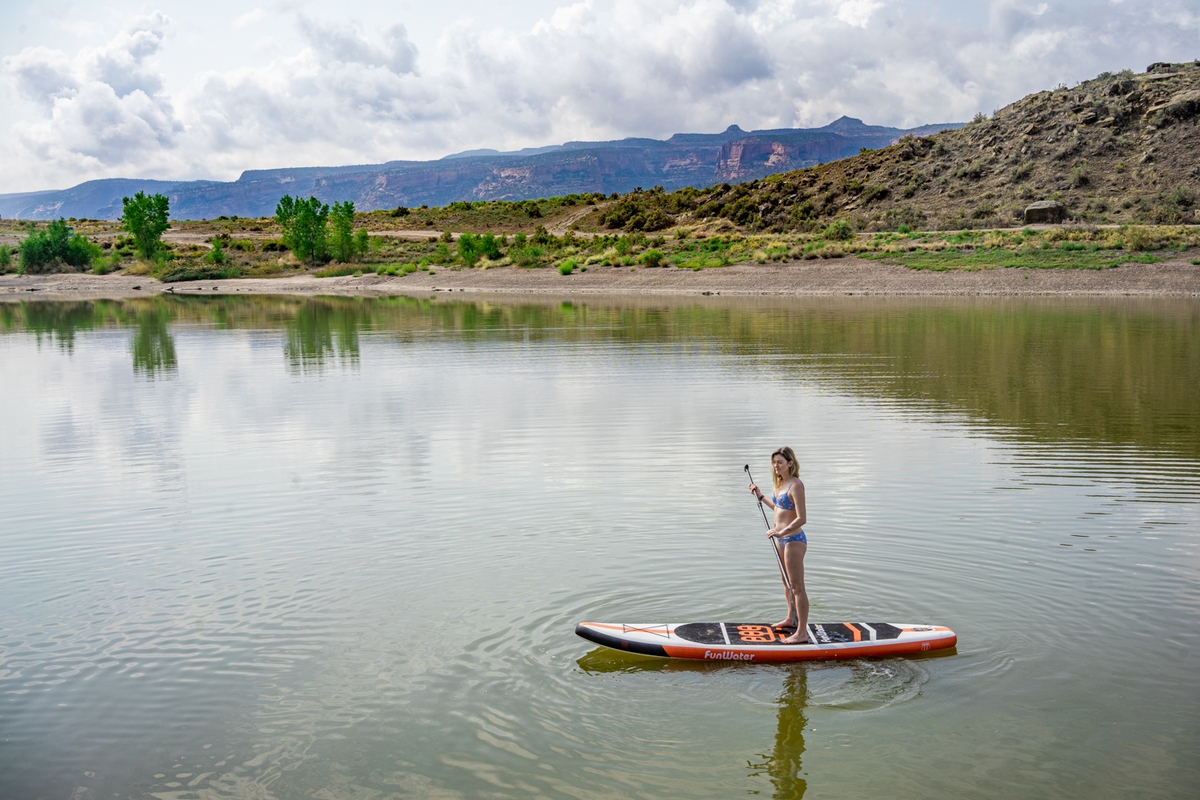
Most of these sit within a few minutes of town. Highline Lake and the James M. Robb sections are Colorado Parks and Wildlife parks, so you pay a day-use fee to get in: $10 a day for a Colorado-plated vehicle or $15 for out-of-state, which is new as of May 2026 and worth knowing if you are visiting, or you can use the $29 Keep Colorado Wild annual pass you add to your vehicle registration. Neither park charges the new $2 surcharge. At Highline, the main ramp is for motorized boats, so head to the East Ramp by the visitor center, which is hand-launch only and the right spot for a paddleboard or kayak. Connected Lakes is limited to hand-propelled, sail, and electric-motor craft, and Corn Lake is your river access.
If you would rather skip the fee, there are good free launches too. I usually put in at Blue Heron or Las Colonias, and the Palisade riverbend and the other free launches around the valley are all worth having on your map. Spring through fall is the window, and calm mornings beat the afternoon wind.
Ruby/Horsethief Canyon
The Ruby/Horsethief stretch of the Colorado is one of the more stunning multi-day river trips in the region. The canyon walls rise hundreds of feet above the river, the road disappears, and for a couple of days it’s just you, the current, and canyon country. The put-in is at Loma, about 15 miles west of Grand Junction, and the take-out is at Westwater Canyon in Utah, roughly 25 miles of river.
It’s accessible to paddlers with basic flatwater skills, since the current does most of the work, and most people run it as an overnighter with a camp somewhere in the canyon. I have not floated it yet. It is high on my list, my buddy Jerald has run it more than once, and honestly I am jealous every time he talks about it.
A few things to plan around. Overnight camping now needs a permit year-round, not just in the summer season, and you reserve it on Recreation.gov. There are 34 designated campsites, one group per site, and one active reservation per person. Reservations open on a rolling two-month window at 8am Mountain time, and you print your permit up to seven days before launch. A day float needs no permit. Watch the fire ban too: in 2026 it runs May 22 through Labor Day, and that includes charcoal.
Whitewater
Westwater Canyon, just across the Utah border, is the whitewater option closest to Grand Junction. It is 17 miles with 11 named rapids in the Class III to IV range, including Skull, Funnel Falls, and Sock-It-To-Me, red rock walls the whole way, and a wilderness feel that’s hard to match this close to a mid-sized city. People run it as a big day or a one-nighter. The rapids are no place to learn, so if you don’t have solid whitewater experience, go with an outfitter.
I have not run it with a guide myself, so I’ll list the options without vouching for any one of them: Rimrock Adventures, based in Fruita, runs a full-day 17-mile trip; Adrift Adventures out of Moab runs day trips around $200 a person with a minimum age of 10; and Moab Adventure Center, OARS, and NAVTEC all run it as well. If you are going private, you pull a permit on Recreation.gov on the same rolling two-month window that opens at 8am Mountain time, which runs $10 per person per trip plus a $6 non-refundable reservation fee. From April 1 to September 30, private use is capped at 5 permits or 75 people a day, so the popular dates go fast.
More to explore near Grand Junction
Water is one slice of it. See the rest of the water and paddling options, the full Explore hub for hiking, biking, and climbing, or build a full day with the things to do in Grand Junction guide.
Have a favorite run or flatwater spot in the valley? Reach out and I’ll add it.